

By Maryam Umar
Old Patriarchy, New Tools
Historically, women are not regarded as humans with bodily autonomy and integrity, but as objects of men’s sexual desires. This is rooted in societal norms that positioned women as inferior to men, despite modernization and evolving socio-cultural trends, the objectification of women as mere sexual exploits is still in vogue and is now amplified through modern technological tools.
Online Gender based violence in Nigeria encompasses various forms of harm, including harassment, cyberstalking, non-consensual sharing of intimate images, and sextortion. This form of violence is both insidious and widespread, yet its very nature makes it difficult to combat.
Notably, both men and women have been victims of online bullying and harassment. Perpetrators hide behind keyboards and abuse their prey to their utmost satisfaction. However, the female gender bears the brunt of this menace than the male. UN Women report shows that women are 27 times more likely to be harassed online than men and a study of five Sub-Saharan African countries, found that 1 in every 4 women had experienced online violence.
When Technology Amplifies Misogyny
A recent report which detailed the monitoring of over 500 social media posts from January to September 2024 reveals that there is a growing prevalence of misogyny and online harassment targeting women, particularly those in leadership positions, female journalists, and women with disabilities. The research identifies various forms of digital violence faced by Nigerian women, including cyberstalking (45.5%), doxxing (10.6%), deepfakes (6.1%), sexting (3%), and revenge porn (1.5%).
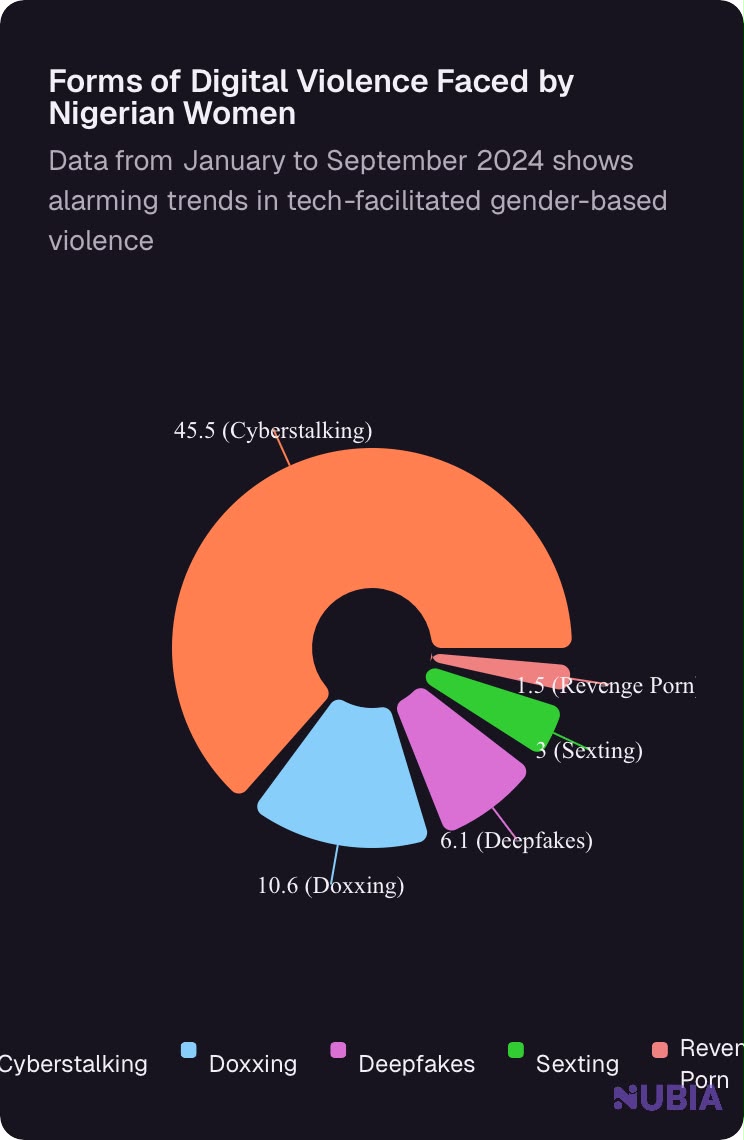
This unequal victimization, according to Jemimah Inyangudo, the first responder for KURAM TechHer’s Online Gender Based Violence reporting and response website, is as a result of the male domination of the internet space. This leads to gender disinformation, when women complain about things online, it’s received differently when men do the same. The conversations are centered around who gets believed and who gets shamed, this kind of policing heightens online bullying and harassment of women.
Grok and the new sexualization of women on X
Violence against women online has now taken a different shape from the traditional verbal shaming and direct abuse to AI powered visible sexualization of women’s bodies. Male X Users are now asking Grok, X’s AI chatbot, to flip uploaded images and videos of women to show their derriere.
A woman shared her photo on X, and one male user asked Grok to “turn her around” and the AI generated an image showing her backside. Seeing this, more men asked Grok to get the woman to do their bidding in the photo. One man asked Grok to “remove her shorts”, another asked the AI to “undress her”, and one man told AI to “make her kneel down while packing her hair backwards”

As technology mediates more of our daily lives, it is also being weaponized to harm women and girls in new and alarming ways. Although not a new phenomenon, technology facilitated gender based violence has surged in recent years and X happened to be one of the enabling platforms. The current grok assisted gender based violence is a Video and image-based abuse– using deepfakes or morphed images that depict survivors in a sexually explicit manner.
The Rise of AI-Enhanced Sexual Violence
A Tech-Lawyer and the Co-Founder of Case Radar AI, Anthonymark Ngwu told Pen Press UDUS that Artificial Intelligence has made the menace of digital violence worse and more visible. “Tools like AI image generators and ‘undressing apps’ now allow bad actors to create sexualised images of women within seconds without even meeting the victim.
This has happened a lot on X, some of the survivors never posted anything suggestive – just normal photos that someone manipulated. What makes this particularly disturbing is the accessibility. These tools are free, require no technical skills, and produce convincingly realistic results. A teenager can now generate revenge pornography of a classmate using just her Instagram photo.
What used to take effort to execute, like stalking, editing, and sharing of those harmful contents can now happen instantly and at scale. Women now face online attacks that follow them into the workplace, their relationships, and even their physical safety. This is not just harassment becoming more visible. It is a fundamental change in the nature and scale of abuse that technology enables,” he added.
Another male X user, after watching a dance video of a lady, prompted Grok to turn her around as he wanted to see her backside. According to him, she can’t just waste his data to watch the video without showing him what he desires. Another man asked grok to “make her hips larger by a couple inches and her waist smaller, and then make her bend over to pick up the mic”
This is not just a trend, it’s a digital manifestation of male ownership over female bodies and consent, an extension of the existing offline patriarchal system, says Jemimah. This socio-cultural clime of our society makes it easy for men to ignore consent and harass women through Non-consensual intimate image abuse (NCII) which means reproducing, producing or publishing intimate content of others online without consent.
The lack of consent that happens offline has now been introduced into the digital space using AI. Jemimah further notes that exposure does not equal consent, just because a picture is available online doesn’t make others entitled to it. Treating visibility as a blanket for consent only reproduces more sexual offenders and pushes victims blaming.
Platform Responsibility ; Is X an enabling environment ?
In 2018, Amnesty International launched a campaign demanding that Twitter take action against the widespread violence against women across the platform. It followed research that demonstrated the harmful impact of violence and abuse against women on Twitter, including leading women to self-censoring what they post, limiting or changing their interactions online, or at times driving women off the platform altogether and causing a chilling effect on women speaking out. The campaign provided a list of specific actions Twitter could take to improve their monitoring and reporting practices and crackdown on online violence. Instead of focusing on these recommendations, the platform is exacerbating online sexual abuse through AI tools like Grok.
Jemimah notes that, It’s easy to weaponize Grok as a tool against women because platform design is capitalistic and profit oriented, more users earn more money so tech companies find it difficult to limit or regulate the instructions users feed them. She recounts making a video about how an AI while conversing with a 12 years old asked him to send his nudes. The weak policies around sexual conversations with AI tools enables indiscriminate abuse.
According to Anthonymark, there’s a policy gap around platform responsibility. Nigerian law does not place strong obligations on platforms to act quickly when harmful content is reported. Twitter, Telegram, and others can host thousands of deepfake images with minimal consequences. There are no clear timelines, no penalties for platforms that ignore victims, and no user education requirements.
Beyond the Grok enabled abuse on X, a far more visceral form of digital violence is fast becoming common : the creation of non-consensual deepfake pornography. Across platforms like Telegram and the dark web, Nigerian men are using increasingly accessible AI tools to generate sexually explicit videos and images of women. They take a woman’s social media photo, a graduation picture, a selfie with friends, a professional headshot and feed it into an algorithm that pastes her face onto the body of a pornographic actor.
The psychological trauma for survivors is immense. They are forced to see themselves violated, their autonomy and identity stolen and twisted into a caricature of male fantasy. They are gaslighted by perpetrators and dismissive onlookers who argue, “It’s not real, why are you so upset?” This question ignores a fundamental truth: the violation is real. The intent is real, the humiliation is real, and the damage to a woman’s reputation, mental health, and sense of safety is devastatingly real.
Legal Grey Zones ; Nigeria Outdated Laws
Anthonymark notes that Nigeria’s laws offer some protection, but they do not fully address the reality of AI-enabled harm. Cybercrimes (Prohibition, Prevention, etc.) Act 2015, criminalises cyberstalking, bullying, and the distribution of intimate images without consent. The Violence Against Persons (Prohibition) Act (VAPP Act) also covers psychological and emotional abuse. However, none of these laws were drafted with modern AI technology in mind.
For example, the Cybercrimes Act talks about “images of a sexual nature”, but it does not clarify whether AI-generated fake images of someone count as sexual content. A clever defence lawyer can argue that no real nude existed. That gap alone shows that our laws need updating. The Act also requires proof that images were obtained without consent. But AI-generated images were never “obtained” rather they were fabricated. This creates a loophole perpetrators can exploit.
We are also lacking a dedicated legal framework for digital consent, deepfake crimes, and algorithmic abuse. Countries like the UK have already updated their laws to make deepfake porn illegal even if the images are fake. Nigeria has not taken that step yet. For survivors like Bisi, these legal gaps mean that even when the abuse stops, justice remains out of reach.
Way Forward
Anthonymark advised that Platforms should start by acknowledging that AI-enabled abuse is not “ordinary misconduct”, it is serious harm. To combat this widespread abuse, they need better detection tools. The same AI that generates deepfake pornography can also detect manipulated images. Companies like Meta already use AI for misinformation. The same energy should be applied to spotting sexual deepfakes. This technology exists and companies like Microsoft and Google have developed tools detecting AI-generated content with over 90% accuracy. Platforms choosing not to deploy these tools are choosing profit over protection.
He also called for faster and more transparent reporting systems as in the status quo, women often report harmful images only to receive vague responses like “this does not violate our community standards”. That needs to change. There should be dedicated categories for AI-generated abuse, with a clear process and strict takedown timelines. Currently, women must navigate multiple menus, provide extensive proof, and wait days for responses. Meanwhile, the content spreads.
And crucially, platforms like Telegram – which hosts many anonymous groups – must enforce stronger group moderation rules. In India, Telegram had to remove deepfake communities after public pressure. Nigerian women deserve that same level of protection. And finally, platforms should educate users on digital consent, image rights, and AI manipulation. If they can run ads for elections and sports betting, they can also run safety campaigns. Until we strengthen these areas, women will continue to face online harassment with limited protection.
While legal reforms are pursued, grassroots organizations are stepping into the breach to provide immediate relief. The Founder and CEO of Brain builder youth development initiative, a non profit fighting technology facilitated sexual and gender based violence, Mr Abideen Olasupo said it’s unfortunate that Artificial Intelligence has made sexual abuse easier for people with sinister motives. However, there’s no technological tool with immense advantages with no disadvantages.
He disclosed that his organization has developed an AI tool that is being used to tackle technology facilitated gender based violence. “We are leveraging AI for women to get their cases reported, clinical psychology support, mental health support, bringing down the post and even free legal services,”