

By Shero Abbas
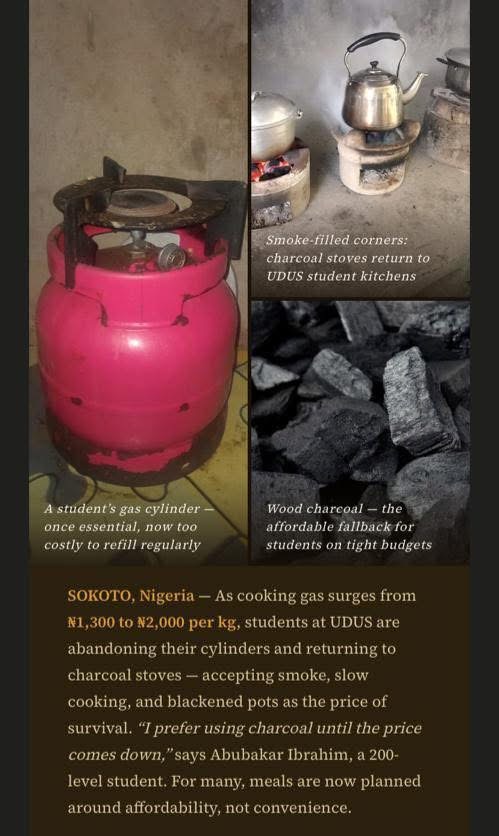
For many students at Usmanu Danfodiyo University Sokoto (UDUS), cooking with gas was once seen as a safer, faster, and more convenient alternative to charcoal. But as the price of cooking gas continues to rise across Nigeria, many students are abandoning their gas cylinders and returning to charcoal stoves despite the smoke, stress, and time involved.
What was once considered an outdated method of cooking is gradually becoming a survival strategy for students on the UDUS campus.
Over the past few months, the price of Liquefied Petroleum Gas (LPG), commonly known as cooking gas, has increased sharply. Students who previously bought gas at around N1,300 per kilogram told Pen Press UDUS that the same quantity is now sold for between N1,700 and N2,000, depending on location and availability.
The increase has placed additional pressure on students already struggling with rising costs of transportation, food, electricity, and accommodation. For many of them, the only affordable option left is charcoal.
Behind hostel blocks and in small corners around off-campus residences, smoke from charcoal stoves has become more visible. Students now gather around small local stoves, fanning flames while waiting for food to cook slowly.
Gas Cylinders Left Unused as Prices Soar
Abubakar Ibrahim, a 200-level Business Administration student, said the return to charcoal was not something he ever imagined during his stay on campus, but the situation has changed everything.
“The sudden hike in the price of cooking gas has made me abandon my gas cylinder and go back to using charcoal despite the challenges and stress involved,” he said.
According to him, he initially believed the increase in price would only last for a short period, anticipating intervention from the government or relevant authorities.
“I thought the hike was temporary and that the price would later come down. I expected the government to address it, but everything keeps increasing instead,” he added.
Abubakar explained that when gas sold for around N1,300 per kilogram, refilling his cylinder was manageable. But now, even buying three kilograms feels expensive.
“I prefer using charcoal until the price comes down because I can no longer cope with the situation on the ground,” he said.
Similar Situations, Different Realities
The situation is similar for Mohammed Yusuf, a 100-level Biochemistry student, who said he had disliked cooking with charcoal long before gaining admission into the university.
“I hated cooking with charcoal even when I was at home, and that was why I bought a gas cylinder before coming to school. But to be sincere, I’m no longer using the cylinder because the price of gas has skyrocketed,” he said.
Yusuf owns a six-kilogram cylinder, which he previously filled for about N8,000. Today, according to him, refilling the same cylinder costs nearly double, as it now costs close to N14,000. He believes it is too expensive and has had no choice but to adapt to charcoal.
Beyond the financial burden, students say charcoal comes with physical stress and health concerns. Cooking takes longer, pots become blackened with soot, and smoke often causes discomfort, especially in crowded residential areas.
Maryam Bello, a 300-level Education Chemistry student, said she has developed a mixed survival strategy to reduce her spending on cooking gas.
“The increase in gas prices has forced me to create another style of cooking. I now combine both charcoal and gas depending on my daily schedule, which works well for me given the increase in gas prices,” she explained.
Maryam described the current situation as frustrating, especially for students who depend on limited allowances from parents and guardians.
“I cannot believe that buying even three kilograms of gas has become difficult because the price is too high for students, especially people like me who depend financially on their parents,” she added.
The Hope That Came With Gas Cylinders Is Fading Away
For some students, the return to charcoal feels like going backwards after finally upgrading to gas cooking.
Abdullahi Abubakar, a 200-level Political Science student, recalled how he stopped using charcoal during his first year after saving money to buy a gas cylinder.
“When I entered school, I was using charcoal, and later I was able to buy a gas cylinder because it made cooking easier and faster,” he said.
Abdullahi said gas prices began increasing rapidly around February this year, leaving him with no option but to abandon the cylinder and return to charcoal.
“I thought the price would remain around N1,300 as it was earlier this year, but suddenly it increased to N1,700 and now even N2,000 in some places,” he said.
The rising cost of gas has also changed the way students prepare certain meals.
Ahmed Naziru, a 100-level Agricultural Science student, said he no longer cooks beans entirely with gas because of how quickly it consumes fuel.
“I stopped cooking beans with gas completely. I use charcoal to parboil the beans and then use gas to finish the cooking,” he said.
According to Naziru, using gas alone forced him to refill his cylinder before the end of every month. Since combining both methods, his gas now lasts much longer.
Data from Vanguard news shows that Nigeria has experienced repeated increases in the prices of cooking gas and other household energy sources in recent years, with students among the most affected groups.
For students in Sokoto, the issue goes beyond cooking methods. It reflects the wider economic hardship affecting daily life on campus.
Meals are now planned around affordability rather than convenience. Students ration food, reduce the frequency of cooking, or seek cheaper alternatives simply to survive through the semester.