


By: Abdulazeez Hikmah
Ayo Oziofu Precious posts nightwear for sale on WhatsApp and TikTok every morning before her lectures start. After school, she arranges deliveries, and for customers outside her campus but within Sokoto, she sends orders by Amana Ride.
The 300-level Mass Communication student at Usmanu Danfodiyo University, Sokoto (UDUS) said she still completes her assignments and reads for her tests and examinations. She started the business, she said, so she could stop asking her family for money for small things.
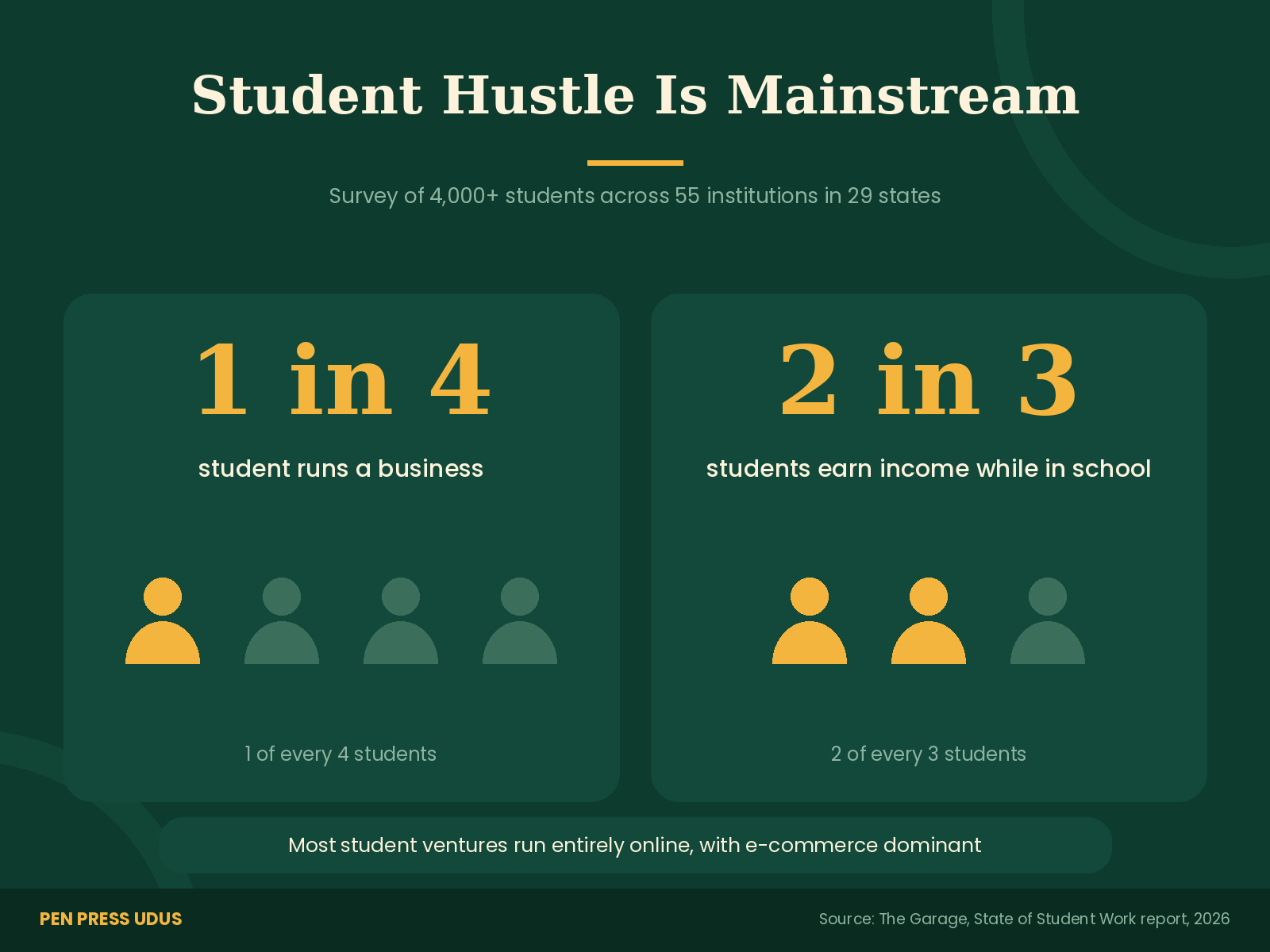
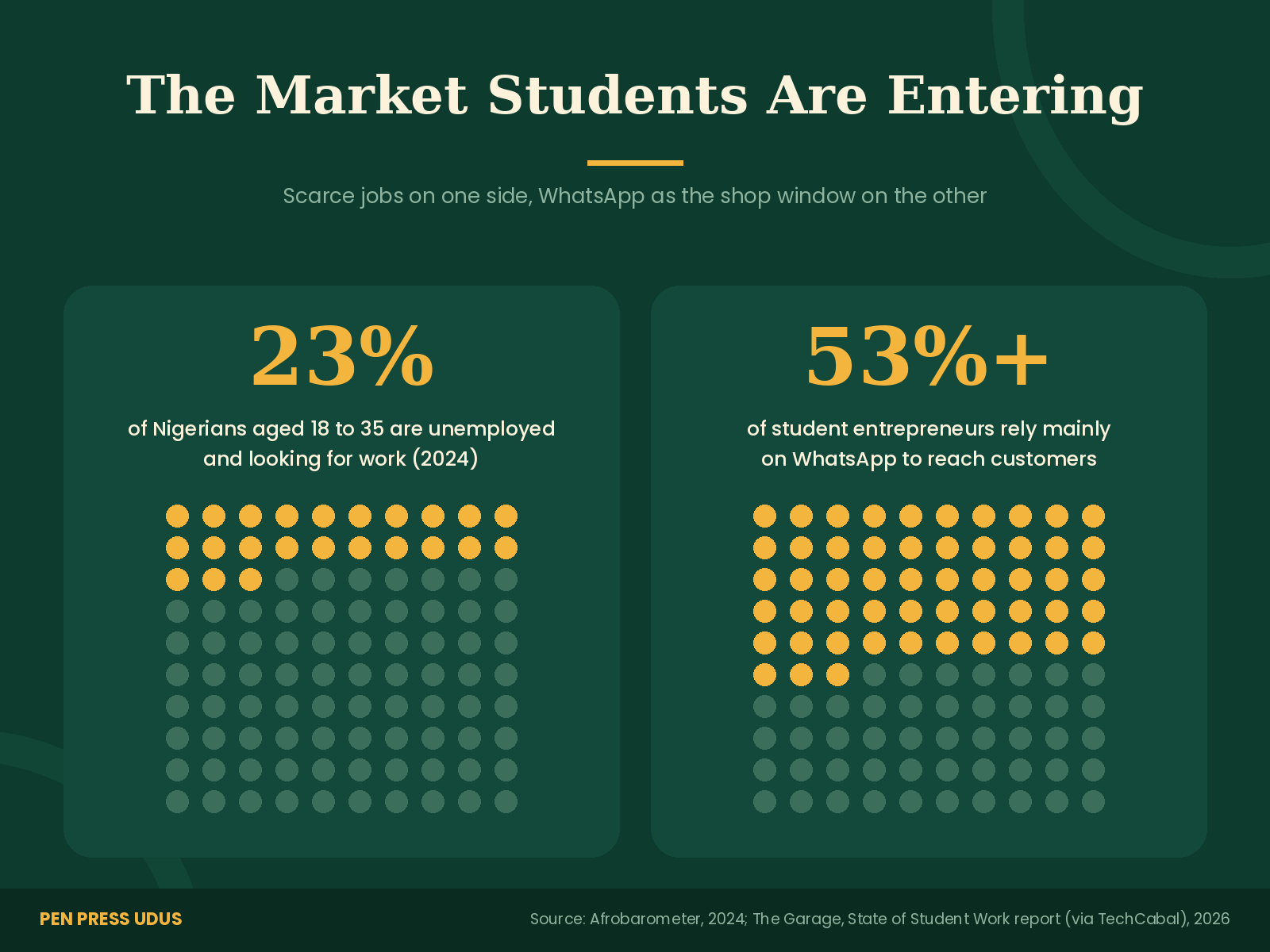
She is one of six students interviewed for this report who run businesses or take paid work while studying. They are part of a larger group. A 2026 survey by The Garage of more than 4,000 students across 55 tertiary institutions in 29 states found that one in four runs a business and that two-thirds earn income while still in school despite studying in a labour market where 23 per cent of Nigerians aged 18 to 35 told Afrobarometer in 2024 that they were unemployed and looking for work.
For the students interviewed for this report, the money pays for transport, food, academic materials and, in one case, support for a younger sister. Each described adjusting their schedules around lectures and examinations, and several said the balance demands planning, discipline and difficult choices.
Seeking Financial Independence
Precious told Pen Press she wanted to meet her needs without constantly asking her family for money. As the first child, she also hoped to support her younger siblings whenever possible.
“There are a lot of difficulties, and I was tired of calling home to ask for little things. I knew that if I started my own business, I could provide for myself,” she said.
She narrates that her previous snack business took more time because she had to buy ingredients and prepare the products herself. But her current business, which involves selling nightwear, is easier to manage, she said, because she can choose when to collect her supplies.
Precious said some people criticise her for focusing on her business.
“People bully me that I am not concentrating and that I don’t focus on my education because I focus on my business. But I still do all my assignments, I still read for my tests and examinations,” she said.
She discloses that the business pays for her transportation, academic materials and personal expenses, and that she uses some of her earnings to support her younger sister. She is careful about spending her business capital, she said, because she wants the business to grow.
Precious advised students who want to start businesses to identify the needs of people around them and begin with the money available to them.
“If you don’t have ₦50,000, just start your business with what you have. If you are staying in a hostel and you notice that people need pads, start with that. If you want to sell necklaces, sell them to students. People are definitely going to buy,” she said.

Sanni Muhammad Babatunde, a 300-level Computer Science student at the University of Ilorin, earns money as a freelance graphic designer and printing specialist.
“I realised there’s nothing out there for graduates, as the situation in Nigeria is not helping at all,” Mr Babatunde said, adding that he therefore took his side business seriously while still in school.
He said he works more during school breaks and less during academic periods. Sometimes he works while attending lectures, especially when handling urgent jobs for clients.
Examinations are the hardest period, he said, because he completes clients’ jobs while preparing for his own examinations.
Babatunde said the business has improved his working ability and widened his knowledge and experience personally, financially and academically. He advised students who want to combine business with education to develop a working schedule and plan their days ahead so that neither suffers.
“Trust me, starting a business while in school is one of the best things any student, both male and female, can venture into. But you should be prepared for any possible setback and draining obstacles. The road is not easy, but it’s worth it at the end of the day. There is this saying: there is light at the end of the tunnel,” he advised.
Turning Passion into Profit
Ibraheem Suaibat Subuola, a 500-level Agricultural Economics student at UDUS, owns Aniberry’s Treats, where she makes cakes and pastries, packages snacks and prepares surprise packages. Her interest in baking began with curiosity.
“I was always wondering how things are being put together to make something this beautiful,” Suaibat said.
Baking gives her both enjoyment and a way to earn money while developing a practical skill, she said, though combining it with lectures, assignments and reading is hard.
“Balancing education with business, assignments, reading and all isn’t always easy,” she said.
When academic activities clash with baking or delivery schedules, she tells customers and adjusts her plans. She said running the business has helped her relate some of what she learns in Agricultural Economics to practical situations.

Azeezat Olarewaju, a final-year Animal Science student at UDUS, also turned baking into a business. She owns TASTELAB BAKES N MORE.
“My passion for baking and creating memorable experiences for people inspired me to start my business,” Azeezat said.
She also reiterates that balancing lectures, practicals, assignments and customer orders can be challenging. But she navigates it by scheduling orders around her free time and accepting fewer during examinations.

Working Beyond the Lecture Hall
Some students earn money through physically demanding jobs instead of conventional businesses. Durojaye Muhammad Mustapha, a 200-level Human Kinetics Education student at the University of Ilorin, works as a painter and does night security work at the university’s Researchers’ Lodge.
Durojaye said his desire to become financially independent motivated him to start working. The income covers his transportation, food and academic materials, he said. He arranges the work around lectures and examinations, sometimes working at weekends, during holidays or after classes.
“I didn’t want to depend on my family for everything, and I always put my academics first,” he said.
The work can leave him physically exhausted on days when he still has an assignment or test to prepare for, he said, and he sometimes turns down jobs that clash with important academic activities.
“It’s not always easy, especially when you need the money, but I’ve learned that some sacrifices are necessary,” he added.
Despite the challenges, Mr Durojaye said the work has taught him responsibility, patience and time management.
Abdulazeez Rofiat, a 200-level Mass Communication student at UDUS is a hairstylist. She said she started the business to earn her own money and develop herself.
“I started because I want to have my own money, not to replace my parents’ support but to build myself,” Rofiat said.
She said two customers can arrive at the same time, or a customer can book a day on which she has an examination or test. When that happens, she chooses her education and reschedules the appointment.
How Common Are Student Businesses?
The accounts of these students sit within a wider pattern. The Garage’s State of Student Work report, covered by TechCabal, found that most student ventures operate entirely online, with e-commerce the dominant type, and that more than 53 per cent of student entrepreneurs rely mainly on WhatsApp to reach customers.
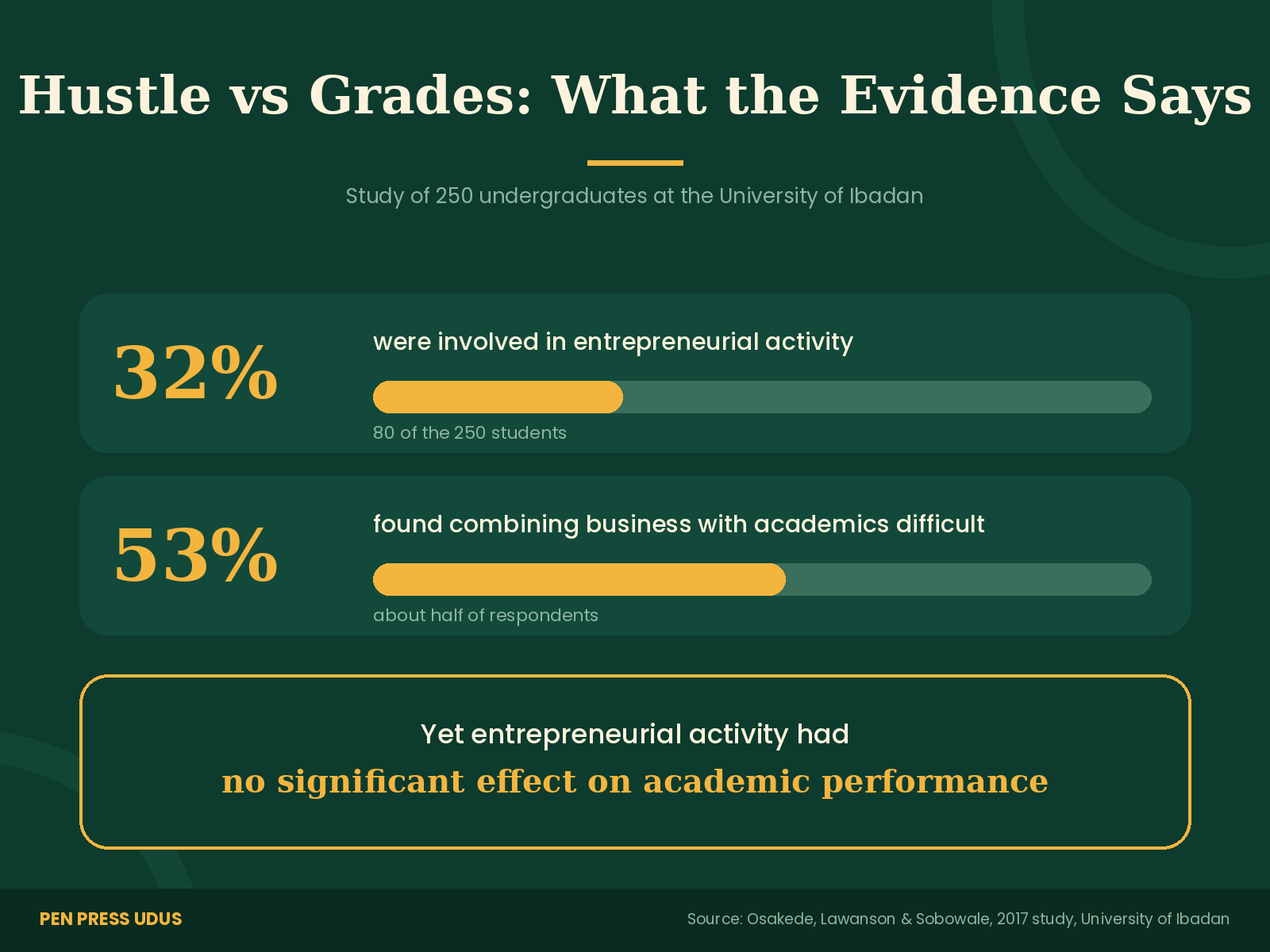
A 2017 study by Uche Osakede, Akanni Lawanson and Deborah Sobowale examined 250 undergraduates at the University of Ibadan. It found that 80, or 32 per cent, were involved in entrepreneurial activity. About 53 per cent perceived combining business with academics as difficult, yet the study found that entrepreneurial activity had no significant effect on academic performance.
What Students Gain Beyond Money, According to an Economist
Dr Bello Audu, an innovation economist at UDUS observes that students start businesses for different reasons, including financial independence, personal interests and the influence of friends already in entrepreneurship.
He said some students also invest part of the money they receive from their families or the Nigerian Education Loan Fund (NELFUND) in small businesses.
Dr Audu said running a business helps students develop practical skills in customer relations, service delivery, patience and responsibility, and that these skills can be useful in the labour market. He, however, named time management as the major challenge.
“Time is the most scarce resource we all have,” he said.
He explained that students must plan their schedules carefully because time spent studying cannot simultaneously be used to manage a business.
He advised student entrepreneurs to organise their business activities around their academic timetables and prioritise lectures, examinations and other important academic commitments.
He also said limited time, money and labour can prevent students from expanding their businesses while in school, and encouraged them to set realistic goals and avoid letting business responsibilities affect their academic performance.
Dr Audu said the cost of buying supplies and transporting goods can reduce students’ profits. He suggested that students running similar businesses form groups or WhatsApp communities to organise purchases and share transport costs. One person could buy supplies for several business owners, reducing the transport expense each of them incurs.
He also advised students to keep adequate stocks of frequently used materials and to set prices that fellow students can afford while keeping their businesses profitable.
According to him, student businesses contribute to the economy by connecting manufacturers with consumers and providing services that make life easier on campus. Those that grow beyond university, he added, could eventually create jobs for others.
Dr Audu adds that universities and government institutions have a role in helping student businesses grow. He called for practical entrepreneurship education in universities and proposed government-backed funding schemes, run through universities, that would give loans to students who want to start or expand businesses. Students who manage such funds responsibly and maintain satisfactory academic performance could qualify for grants after graduation, he said.
He also recommended that universities provide environments where student entrepreneurs can operate, receive training and access business guidance. He said such support could help young people build sustainable businesses, create employment and contribute to economic growth.