
By Luqman Kamaldeen Oladayo
For Aishat Muhammad, a 300-level Law student at Usmanu Danfodiyo University Sokoto (UDUS), a simple notification brought two years of academic anxiety to a sudden halt “CGPA is now available on the new students’ portal”
But the fleeting excitement that swept across the campus masked a deeper, unresolved crisis. Behind the newly visible grades lies a frustrating trail of duplicated courses, missing scores, and a digital system struggling to survive a nationwide curriculum transition.
Aishat was excited to finally have a compass after two years of uncertainty, blurry grades and the confusion that came with having a portal with no visible Cumulative Grade Points Average (CGPA). Even though the calculations she had done for her first two years were inaccurate, finding out earlier was still fulfilling.
“My first two years were painfully long. I was so confused because I did not know my CGPA. It’s like moving forward without knowing where you are going,” she says.
Aishat, like many others, lost her motivation due to the situation and could not tell whether she needed to work harder or study smarter. “I had no clear direction on what to improve on because we didn’t know where we stood,” she said, adding that she has friends who have issues of missing grades in the same portal.
Recognizing this challenge, the National Universities Commission (NUC) Digitalisation Guidelines for Nigerian Universities has provided solutions on how institutional ICT challenges like course registration, examination records, and student administration can be addressed efficiently.
A maze of missing grades and duplication
Interviews conducted by Pen Press UDUS reflect that, the general inconveniences faced by students transcend the absence of CGPA on the portal–with many students resorting to manual calculations which were often inaccurate.
Ibrahim Ayomide Solomon, another 300 level student of history, recounted his struggle of accessing the portal during his first year. Being a new student exploring a new portal, he found it difficult to meet senior students who knew about it because they were at the time using a different portal.
Sulaiman Yusuf, a 300 level Economics student has also, on several occasions, encountered difficulties in navigating the new students portal. Being the class representative of his class, he carries not just the burden of his complaints but together with that of his classmates. At the beginning of a new session, different problems surfaced, primarily due to the inaccessibility of their 200 level results reportedly released by the examinations officer.
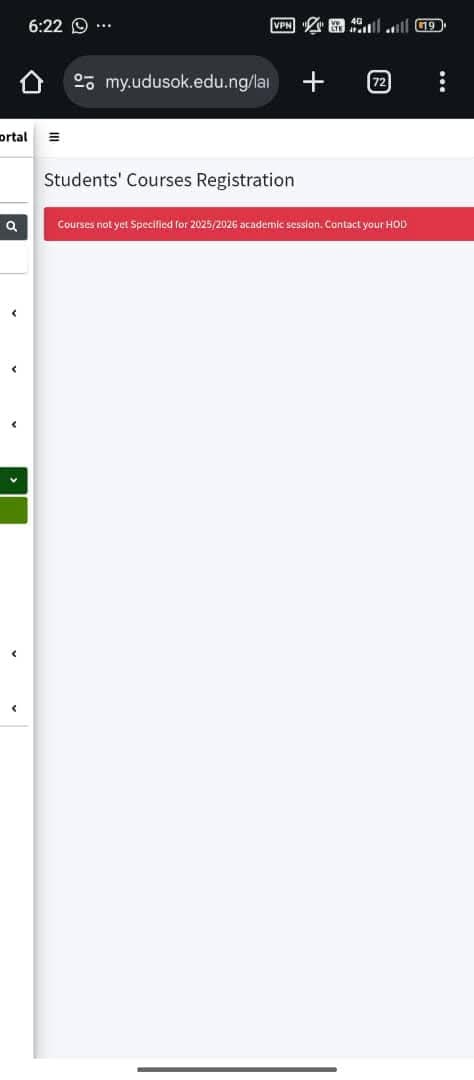
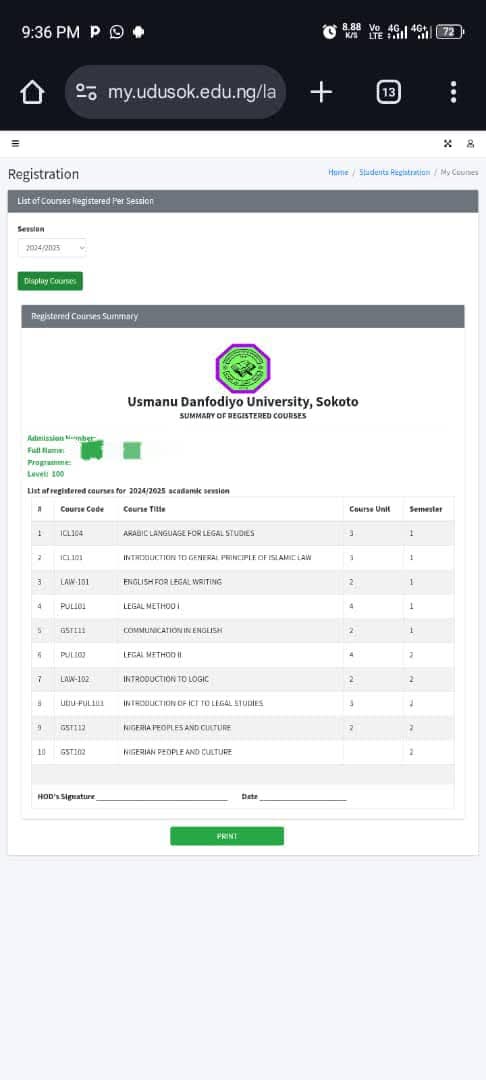
In addition to this, no course was displayed for registration for their current level while General Studies (GST) courses are still in duplications. “The adequate development of the portal ought to be questioned. The same issues keep rising every session: difficulty in course registration and duplication of results,” Yusuf laments, visibly frustrated.
The challenge faced by the third year Economic students is not isolated, Yusuf revealed that one of his friends is still dealing with a portal that has put her through myriads of inconveniences.
While speaking with Pen Press UDUS, Sheriff zuleihat, a 300 level Demography and social statistics student disclosed that things started smoothly with no issues in her first year, until her 200 level. It all began with a little glitch when 100 level was displayed on her portal instead of 200 level and the wrong amount of tuition fee paid. She wrongly assumed that it could be rectified without much complications.
“Since then, I started having endless different issues in my portal,” she lamented.
After necessary complaints and rectification of the issue, Zuleihat thought the problem would end with that academic session but she was wrong. The situation with her portal became worse when her 100 level courses started mixing with 200 level courses, a problem that still persisted at the time of this interview. Even the recent developments of results history displayed 200 level results twice.
“I have made complaints and written letters to the Management Information System (MIS) thrice but no changes have occurred since,” she says .
At the heart of these challenges, Yusuf wonders why the system adopted by the school management does not allow students to access, add and drop courses in their portal whenever they make mistakes during course registrations.
“The institution should try as much as possible to perfect their digital platforms for efficiency,” he noted.
Management response ; the root of the crisis
Amidst the plethora of complaints made by affected students. Mallam Rilwanu Mohammed Ladan, the Director of Management Information System (MIS) acknowledges students’ plights and promised that due steps will be taken for the swift resolution of the issues.
He further noted that the recent blackout across the University community has made works tedious and tardy to execute. “We are working tirelessly on it. By next week, Inshallah you would not see the duplicated courses anymore,” he promised.
The idea of the transitioning from Benchmark Minimum Academic Standards (BMAS) to the Core Curriculum and Minimum Academic Standards (CCMAS), introduced by the National Universities Commission (NUC) was, according to the director, the foundation of the problem.
The new academic standard provides 70% courses for Universities nationwide and gives Universities the liberty of choosing the remaining 30% known as elevated courses. Consequently, adding and dropping courses become risky for students and has put carry-over students in a dilemma of which course to register. “Courses with UDU are the new courses with distinct units making carryover students find it difficult to register them with the current UG 1 and 2 students” he noted.
In response to the ongoing agitation among students, the director had organized meetings with the management addressing how to strike a balance between the already existing BMAS and the newly introduced CCMAS, adding that the MIS section is not the custodian of CCMAS but the academic planning.
The director explained how the uploading of results systems normally works, which is granting each lecturer the ability to upload the results of the courses they taught themselves. However, instead of performing this function, they give these grades to the faculty examinations officers to upload for students.
“But whenever a problem eventually occurs every student and lecturer resorts to MIS,” he said.
He further noted how meticulous they must be before changing any course or grade for students. They are required to make a lot of background enquiry as any wrong changes of grades or courses would result in MIS being responsible for it, which would undermine their competency if contrary is proven.
“ Our job isn’t in academics. Bear with us as we address all issues appropriately,” he stated.
Measures are Already in Place to Facilitate Solutions
The director explained that every faculty in the University has officers who address the same issues as MIS and serve as its delegate. But, the current system doesn’t allow most of them to work in their respective assigned faculties.
As a result of this, they are all stationed at the MIS section in the Vice Chancellor’s blocks, each assigned to man a computer and then perform their functions in accordance with the directives given by the director for efficiency.
“It’s not the issue of changing the portal, but the issue of the introduced CCMAS,” he clarified.
The Director also contends that the MIS is working together in collaboration with Mallam Lawali Bala, the HOD Software Development in sanitizing its data to solve all issues appropriately and decide the courses to be taken for both new students and carry over students in different situations. When all issues are resolved, they would subsequently sprung into action immediately.
“These problems aren’t caused because we change the student portal. It is the emergence of the new syllabus,” he emphasized.
He further explained that the new portal at the back end is the same with the old one— same structure. The decision of designing and transitioning to the new portal was because the earlier one did not give room for development and adjustments as necessary.
Understanding the CCMAS Transition
The Nigerian University System has in 2023 transitioned from the Benchmark Minimum Academic Standards (BMAS) which has been in use since 2007 to the Core Curriculum and Minimum Academic Standards (CCMAS). This curriculum was introduced by the National Universities Commission (NUC) to reflect 21st-century realities, standardize academic contents and emphasize industry-relevant skills.
While BMAS focuses on course content, CCMAS introduced in 2022/2023 focuses on learning outcomes, competencies, and skill acquisition; while providing 70% of the curriculum, universities are expected to develop the remaining 30% to reflect specific institutional peculiarities. Continuous assessment, here, accounts for 30-40% of marks, with an emphasis on practical and project-based learning.
Some of the development of the new curriculum is the unbundling of the old Mass Communication programme into a full Communication and Media Studies discipline. This has resulted in modifications in different areas of this course ranging from foundation courses,writing and reporting, broadcast and film, public relations and advertising, digital and news media, to research and professionalism.
In addition, the CCMAS introduced a restructuring that covers 17 disciplines contrary to the initial 13 disciplines covered by BMAS, and emphasizes necessary soft skills including digital literacy, entrepreneurship, and critical thinking.
This updated curriculum is designed to critically ensure that graduates acquire computer literacy and IT skills, entrepreneurship skills, critical thinking and problem solving skills, communication skills, interpersonal relationships, and make university education in Nigeria more responsive to the needs of the society.