

By Luqman Kamaldeen Oladayo
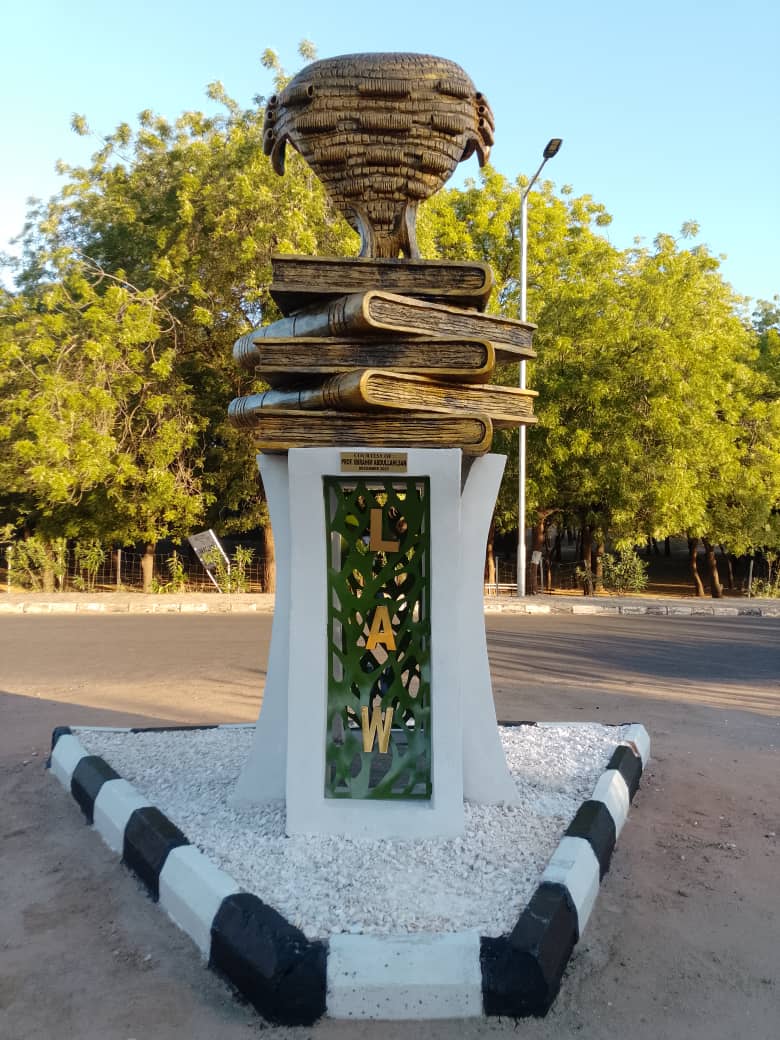
At the early stage of resuming academic activities of the session, it’s a new dawn as the Faculty of Law, Usmanu Danfodiyo University, Sokoto (UDUS), wore a garment that caught the attention of every student of the faculty and the entire university, in courtesy of Professor Ibrahim Abdullahi, SAN, one of the highly respected lectures in the faculty. It teaches identity, controversy, and triggers expectations. Standing boldly before the entrance of the faculty, the sculpture has quickly become more than concrete and design—it has become a conversation.
For many students, the monument signals a shift to modernization. A statement that the Faculty of Law is redefining how it sees itself and how it wants to be seen.
“The new sculpture is a new vibe for the faculty, and it has been modernised,” Rahama Hassan, a 200-level Law student, said, describing the monument as a refreshing transformation. For her, its biggest strength lies in how beauty and law blend nicely, adding an amazing ornament to an academic space.
Beyond beauty, she sees practical impact, inspiration for Law students, and cool photo spots, while suggesting that maybe more symbolic elements could deepen its meaning.
In a more reflective tone, Umar Maryam, a 400-level student, perceives the monument as within the cultural and religious context of Sokoto.
She acknowledged that the previous scale, before the faculty used to be the symbol that distinguishes the faculty of Law from other faculties, and that the feature has been improved now, describing the monument as beautiful.
Yet, she also acknowledged the underlying tension and the blatant reality of our conservative environment with Islam deeply entrenched in our daily lives.
“ This, I think, is the rationale behind constructing a statue that portrays a rather explicit image of a woman,” she asserted.
With no prior expectations, Maryam wasn’t disappointed with the final look of the sculpture. Interestingly, she links the monument to institutional growth, adding that she heard the Council of Legal Education awards quotas to faculty of Law and this new beauty counts as one too.
Sulaiman Asiat, a 200-level student, the monument evokes something even deeper: belonging, beauty and a sense of identity to the Faculty of Law, UDUS.
However, she admits the design does not follow a usual pattern, she opined that its uniqueness is exactly what gives the Faculty of Law a distinct image compared to other faculties of Law across Nigerian universities. While Lady Justice Statue would have been a natural choice, Asiat believes the new design stands out on its own merit.
“This new design also carries new significance and represents justice as well,” she added, as she also points to its external value, noting that it could increase recognition and attract visitors, alumni and also potential sponsors.
According to Healthier and Little’s statue restoration page, it described Lady Justice statue as an artwork depicting the Lady of Justice statue, whether in the form of paintings, sculptures, coats of arms or metal statues, is found throughout the world; North or South America, Europe, Africa, the Middle East, Southern and Eastern Asia, and Australasia. It’s likely see in courthouses, law offices and legal, and educational institutions. The history of the Lady Justice statue goes back many thousands of years, and she typically carries symbols of justice.
“The concept of Lady Justice is very old, dating back to ancient Greek and Egyptian times. Themis, the Greek goddess, represented law, order, and justice, while the Egyptians had Ma’at, who stood for order and carried both a sword and the Feather of Truth. The most direct comparison, however, is with the Roman goddess of justice, Justitia,” the page added.
Asiat suggested more inscriptions that show the meaning it carries as that would help both members and non-members of the faculty to understand its relevance to law and justice.
On the angle of Abdulrazaq Muhibudeen, a 400-level student, relating that the sculpture is a great development to the faculty of law.
He affirmed that the monument signifies the moral and Islamic law principles upheld in the faculty of Law, UDUS, as a human statue is Islamically discouraged, and was sure the monument would generate positive feedback.
“It signifies our culture and affirms that we practice what we preach,” he said.
Like Asiat, what stood out for him is the uniqueness. “I appreciate the fact that we are not following the masses,” he stated. He further reflected on his initial preference for Lady Justice Statue and how his interest has swiftly shifted to preferring the sculpture.
However, not all reactions are celebratory. For Abdullateef Rukayat, a 500-level student, she initially had mixed feelings towards the monument but later recognized that the monument embodies what the Faculty of Law, UDUS is all about.
“To me it is an eyesore,” she said bluntly. Even in criticism, she acknowledges its symbolic depth.
She pointed to the brown wig and books embedded in the design and explained that both represent the procedural aspect of law and the classroom knowledge, respectively.
“The monument serves as a reminder of what is expected of everyone. Encouraging mooting participation clearly differentiates UDUS faculty of Law from other faculties across the country,” she added.