
By Shuaibu Sharifat
Samuel(first name withheld) a 22 years old student said he decided to take his own life on the 12th of February 2025. But looking back now, he feels immense regret for that decision.
“I wish someone had given me a listening ear without judging me,” said Samuel. He survived the depressive phase after his pastor offered him counselling, encouragement and financial support.
Samuel’s survival hinged on one thing many Nigerian youths never get: someone who listened. Days ago, that gap claimed another life, that of Oluwole Oluwaseun, a 500-level Materials Science and Engineering student at Obafemi Awolowo University (OAU), Ile-Ife, whom police say preliminary findings suggest died by suicide. Their stories sit at opposite ends of the same crisis: in a country with limited mental health services and a heavy stigma around speaking up, whether a young person lives can depend on whether a pastor, friend, or stranger happens to be there.
The university’s Public Relations Officer, Abiodun Olarewaju, said in a statement on Wednesday that the university received a distress call at about 1:30 p.m. on Tuesday about an emergency involving the student at his residence in Damico Area, Ooni Layout, Ile-Ife. The Quick Response and Security (QRS) Team went to the scene, where officers from the Nigeria Police’s ‘A’ Division, Moore, Ile-Ife, joined them. A doctor at the University Health Centre certified him dead.
Mr Olarewaju said the university handed items recovered from the scene to the police and appealed to the campus community to avoid speculation. He renewed the university’s call for students facing emotional distress, relationship difficulties or financial pressure to seek help from trusted people and the university’s counselling structures. Osun State Police Command spokesperson Abiodun Ojelabi confirmed the case.
What the national data show
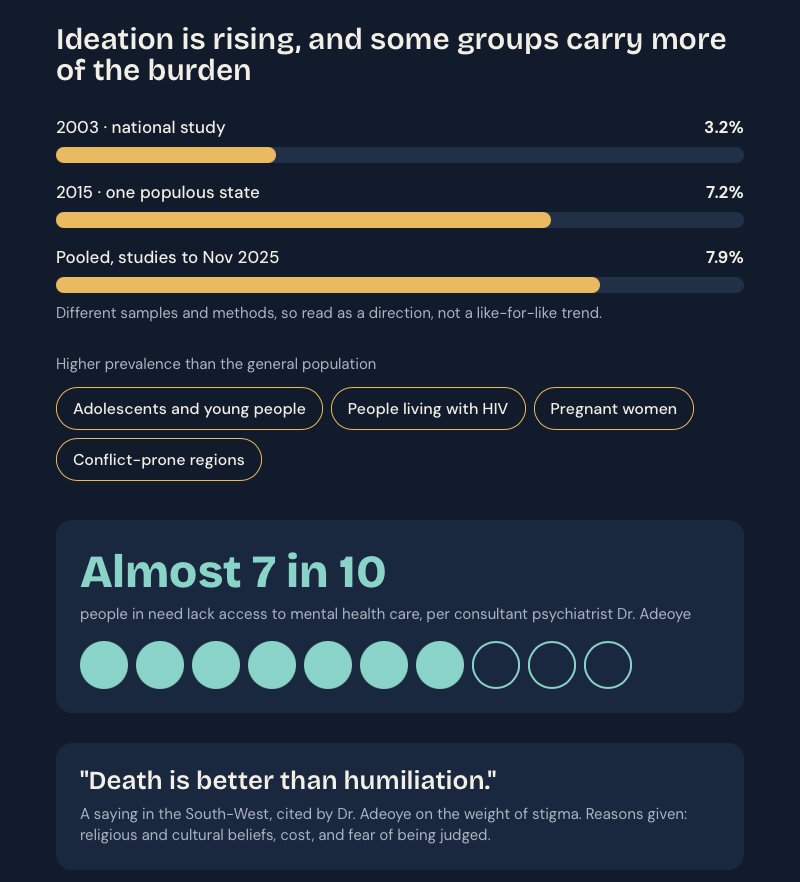
A review of Nigerian medical literature published up to November 2025 pooled 53 studies covering 132,514 people. It estimated suicidal ideation at 7.9%, suicidal planning at 1.9% and attempts at 1.3%. Prevalence was higher among adolescents and young people, people living with HIV and pregnant women, and ideation was more common in conflict-prone regions. It was also associated with marital status, educational attainment and employment status. The review found prevalence rose over time.
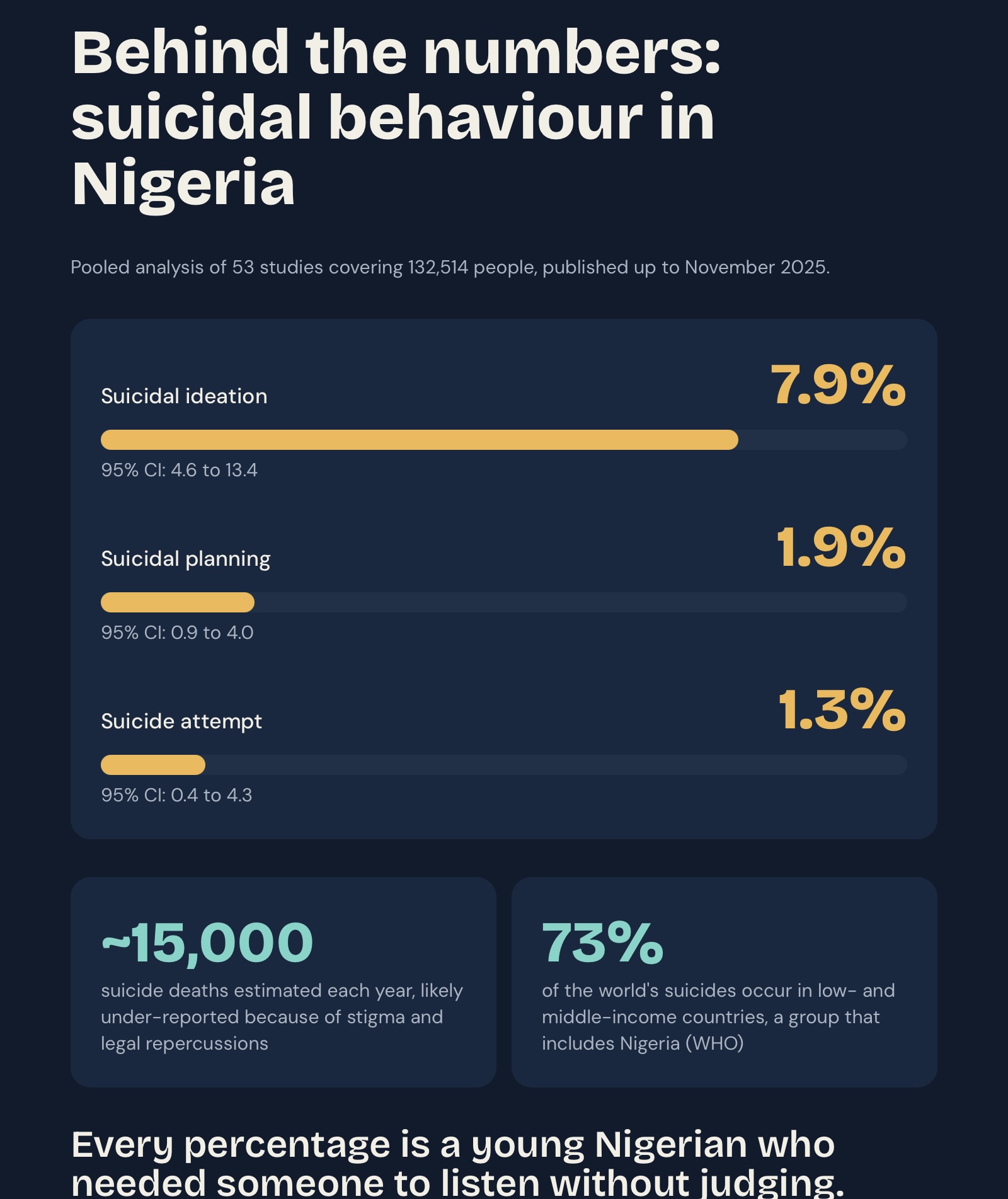
World Health Organization (WHO) estimates that Nigeria records roughly 15,000 suicide deaths a year, though cases are heavily underreported because of stigma and legal repercussions. Suicide mortality is tracked under SDG indicator 3.4.2, and the same data estimates about 73% of global suicides occur in low- and middle-income countries, a group that includes Nigeria.
Stigma and access to care
Consultant psychiatrist Dr Adeoye said stigma is the biggest obstacle to seeking help. She cited a South-West saying that “death is better than humiliation,” and said, “People make speaking up feel like an offence.”
Dr Adeoye said almost 70% of people who need mental health care cannot access it because of cultural, religious and financial factors and stigma. She said the tendency is rising among people aged 18 to 40, and that undergraduates are particularly vulnerable because of financial, emotional, psychological and economic factors. She also said substance use disorder is rising.
What young adults told us
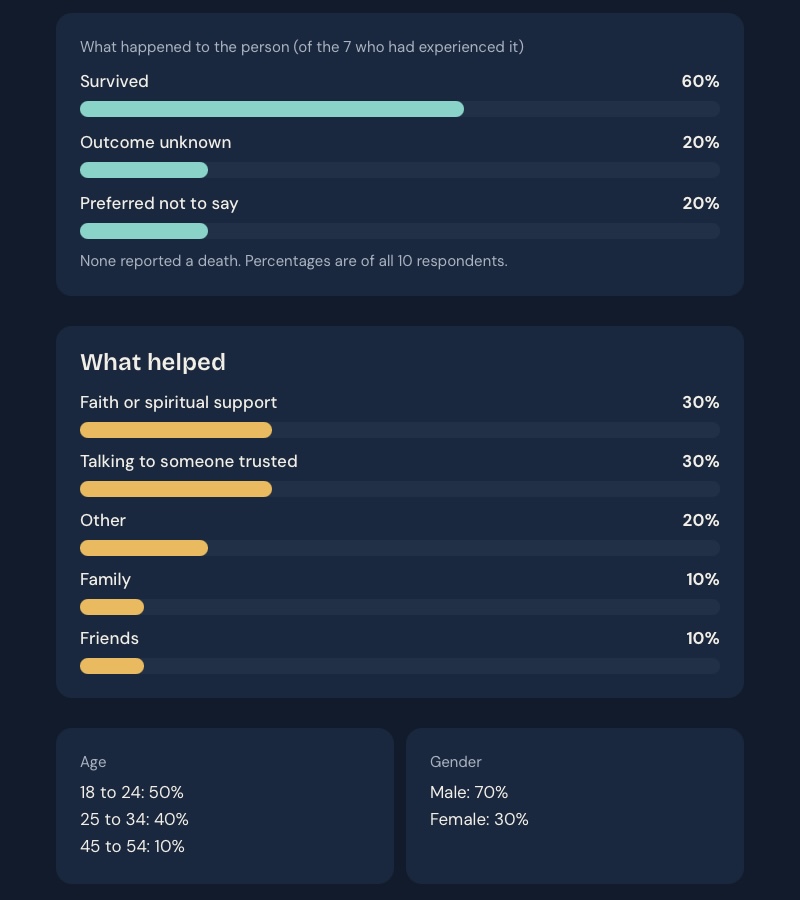
Pen Press surveyed 10 young adults, recruited through social media, by Google Form on 29 and 30 August 2026. Seven said they had experienced suicidal thoughts or knew someone close to them who had. Of the 10 respondents, six said the person survived, two did not know the outcome and two declined to say. None reported a death.
Religious support and talking to someone trusted each accounted for 30% of responses. Respondents called for more accessible counselling, greater public awareness and less stigma. One said seeking help should be viewed as a sign of courage rather than weakness. Another described recovery as “not linear.”