

By Shero Abbas
For many young Nigerians, gaining admission into a university represents an opportunity to pursue dreams, build careers, and secure a better future. But for students living with disabilities, getting into higher education is often only the beginning of a long struggle.
Across Nigerian universities, students with disabilities continue to face barriers that extend beyond the classroom. From inaccessible infrastructure and transportation challenges to social exclusion and financial burdens, their daily experiences reveal a higher education system that remains largely unprepared for their needs.
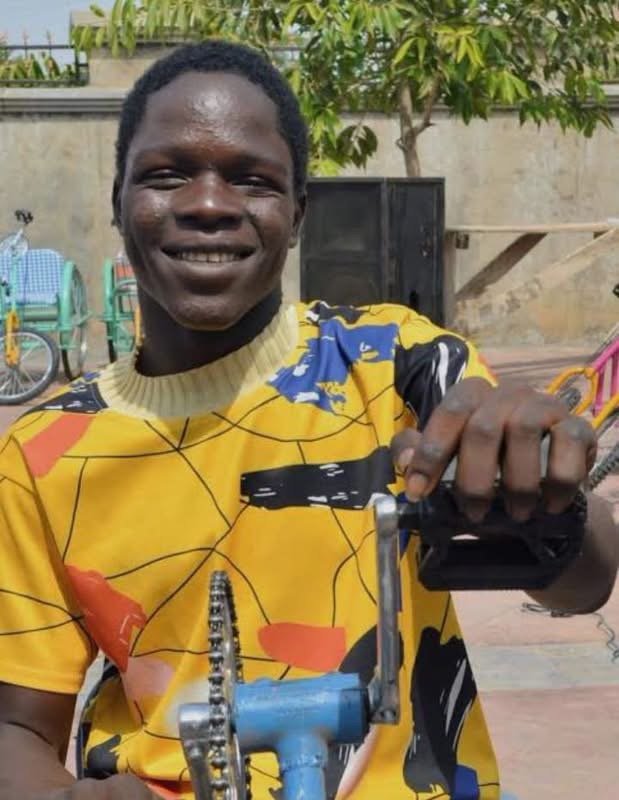
Ishak Ahmed Taku, a 400-level Linguistics student at Usmanu Danfodiyo University Sokoto, has significantly altered the course he once imagined for himself. While growing up, he dreamed of becoming a filmmaker and artist. However, his physical condition forced him to reconsider his ambitions and focus on education as a pathway to independence.
“My dream was to become an artist and filmmaker, because this was what I planned for myself and what I like the most, but life has placed me somewhere else,” he said.
Born into a family of farmers, Ahmed knew farming would be difficult due to his condition. He therefore turned to education as his best opportunity to build a future. Yet even within the university environment, everyday activities remain a challenge, as Ahmed finds it very difficult to trek a long distance.
“Self-mobility has always been my major problem, I cannot trek long distances, and I don’t have a wheelchair. Whenever I need to move around campus, I have to pay for transportation, which creates additional financial responsibilities,” he explained.
The absence of mobility support often leaves him stranded. Simple tasks that many students take for granted can become exhausting obstacles.
“Whenever I want to attend classes, especially those held upstairs, I struggle to get there. I usually manage to climb the stairs because I don’t have anyone to assist me.”
Ahmed’s experience highlights a challenge common in many Nigerian universities where lecture halls, hostels, and administrative buildings are constructed without adequate consideration for accessibility.
A 2023 report by the NCPWD found that 85% of schools in Nigeria are not accessible for the disabled. Students with physical disabilities navigate treacherous terrain, confronting stairs, uneven pavements, and inaccessible facilities. Those with visual impairments struggle to access materials, relying on makeshift solutions or assistance from peers.
Meanwhile, students with hearing impairments face isolation, unable to fully participate in lectures or discussions. Learning disabilities and mental health concerns often go undiagnosed or unsupported, leaving students to flounder in silence.
The Burden of Studying Against the Odds
Yusuf Usman Lakoda, a 400-level Veterinary Medicine student of UDUS explained to Pen Press that attending university was never part of his original expectations.
After completing secondary school, he doubted his ability to continue his education because of his disability. However, his father’s encouragement changed his perspective.
“My belief was that I couldn’t do anything, but my father told me that other people with disabilities were succeeding in school, and that I could do the same,” he recalled.
Motivated by those words, Usman pursued higher education despite his fears and uncertainties. Although he initially hoped to study Medical Laboratory Science, he eventually found himself in Veterinary Medicine.
His journey through university has not been without difficulties. Physical limitations often make academic activities more challenging than they are for his peers.
“My challenges in school can be frustrating because I can’t always do what my colleagues are doing, sometimes I unintentionally miss classes because of my condition,” he said.
Fighting Social Exclusion
Beyond physical barriers, many students with disabilities face another obstacle: society’s perception of their abilities.
Salihu Abbas, a medical student at the University of Ilorin, discloses how he was initially denied access to education because of his disability.
“While growing up, all my younger brothers and sisters were sent to school, but I remained at home,” he said.
As time went on, Abbas’ life changed when an uncle questioned why he had not been given the same educational opportunities as his siblings.
“The day my uncle came to our family house and saw me at home whereas my brothers and siblings were in school he began to question my mother that why am I not going to school?”
Upon enrolling into school, Abbas ranked 28th out of 29 students in his class and struggled academically. Yet determination and perseverance gradually transformed his performance.
“With the help of God and hard work, I eventually became the Head Boy in both primary and secondary school,” he said.
His achievements continued when he won a scholarship in junior secondary school that covered his tuition from Senior Secondary School One to Three.
Determined to Succeed
Muhammad Ibrahim, a 300-level student of Political Science at Federal University Gusau, also understands the challenges of pursuing higher education while living with a disability.
Coming from a financially disadvantaged family, Ibrahim combines his studies with shoemaking to support himself.
“My parents were poor, despite my condition, I learned shoemaking, which helps me earn money and take care of myself,” he said.
Unlike many students with disabilities who are forced to abandon their education due to financial constraints, Ibrahim has benefited from government-sponsored educational support from primary school through university.
“Some of my colleagues who were like me stopped going to school after primary education because they believed they couldn’t continue,” he explained.
Rather than accepting those limitations, Ibrahim chose a different path.
“I told myself that my condition would not stop me from going to school. From that day, I decided I must complete my education,” he said.
Experts’ Contributions
Prof. Halimah Sarkinfada, disability inclusion advocate, explained to Pen Press UDUS that people with disabilities often encounter numerous challenges in society, struggling to access essential aspects of life such as education, employment, social events, and basic amenities.
“Individuals with physical disabilities often encounter barriers to accessing essential academic facilities, including lecture halls, lecturer offices, and examination offices, due to the lack of wheelchair-friendly infrastructure,” she said.
“The government should provide universities with the necessary facilities to effectively implement inclusive policies, ensuring that all amenities available in special schools are also accessible in higher education institutions,” she added.