

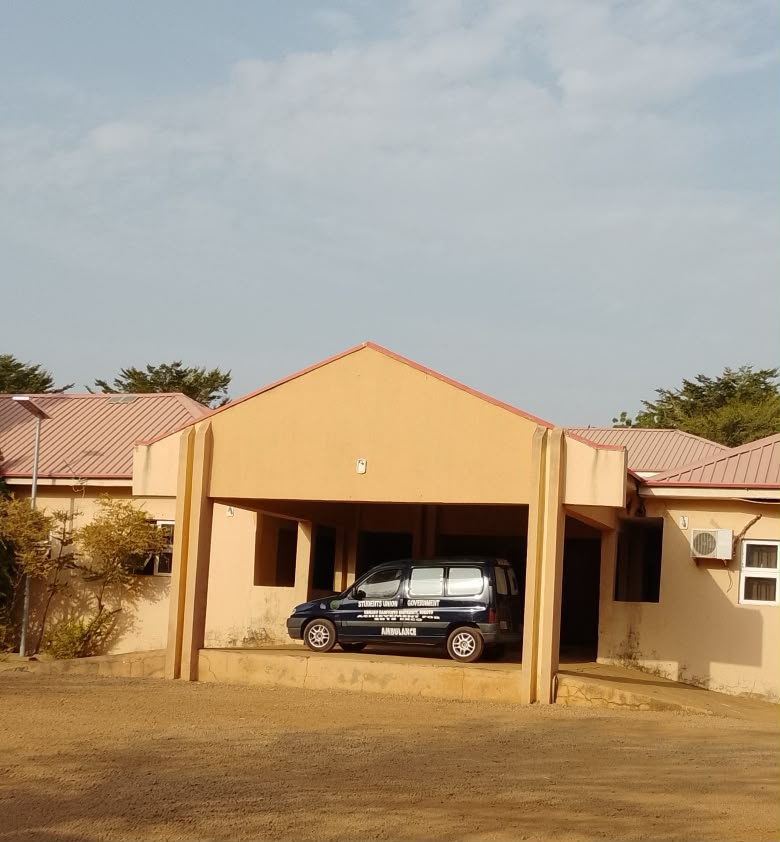
By: Luqman Kamaldeen Oladayo
“The doctor is not on seat.”
Abdulfatai Hammed, a 200-level Law student of Usmanu Danfodiyo University, Sokoto (UDUS), had heard this before. The phrase, now disturbingly familiar to him, is what he says students seeking treatment at the UDUS clinic are sometimes told.
Prior to his own personal encounter, Abdulfatai once watched a friend wilt in pain at the waiting room for hours and had sworn never to seek treatment at the school clinic. That way, he would not have to bother with the long queue or the endless waiting.
So when his fever spiked two months into the semester, he did what he had come to see as a quicker option : he walked past the clinic into a medicine store at the school mini mart, where he could be attended to immediately, even if the treatment came without the formal assessment he expected from a health facility.
Recounting his experience, Abdulfatai explained that the treatment he received at the medicine store began without what he described as proper testing or diagnosis. The attendant arranged for drips and gave him injections which, he said, did not relieve his symptoms.
Barely 12 hours after receiving the treatment, Abdulfatai said his condition became worse. He lost his stamina and required support to walk. His neighbours intervened swiftly by taking him to the school clinic, hoping for emergency care.
But, according to him, they were met with the same response: “The doctor is not on seat.”
Due to the severity of his situation, Abdulfatai was, in the middle of the night, rushed to Usmanu Danfodiyo University Sokoto Teaching Hospital (UDUTH), roughly 15 kilometres away from his campus, where he said he eventually received treatment from qualified health workers.
“I found qualified nurses, doctors and experts who took good care of me. If you are really sick, I advise that you go to the teaching hospital instead,” he said.
His experience is not the only account of students turning away from the university clinic.
Hamzat Amole, a 300-level student of UDUS, said he also gave up on seeking medical care from the school clinic after encountering delays on two different occasions.
On one of those days, while students at Binji hostel were busy with their morning routines, Amole said he was struggling with a serious headache. He decided to wait until noon before going to the clinic, hoping to meet a doctor.
“I waited till twelve before going to the clinic so I could meet the doctor. Surprisingly, I was still welcomed by the words I have always heard — ‘the doctor is not on seat,’” he explained.
Amole said he remained at the clinic until about 4 p.m. before eventually leaving without receiving the medical assistance he sought.
He then walked to a patent medicine store, where he said he could be attended to more quickly.
On another occasion, Amole said he waited for a doctor throughout the day after being informed that one was unavailable. By night, he had given up and bought drugs he was already familiar with, without a formal prescription.
For students like Amole, the problem is not necessarily a preference for medicine stores over qualified healthcare providers. Rather, their experiences suggest that waiting for care can itself become a reason to seek alternatives.
A 2024 study of healthcare utilisation among students at Afe Babalola University, Ado-Ekiti, found that although 87.4 percent of the 429 students surveyed had used university healthcare services, 66.9 percent had a negative perception of those services. The study identified factors including staff attitude, cost and other service-related issues as influencing healthcare utilisation.
An earlier Nigerian study also found that waiting time, availability and experience of staff, organisation of healthcare and continuity of treatment were among factors associated with utilisation of university health services.
The findings do not establish that the same percentages apply to UDUS students. But they provide a wider context for the experiences described by students interviewed for this story.
A Dangerous Alternative
Maryam Umar, another UDUS student, reached a similar conclusion without ever seeing those numbers. After one draining attempt to obtain a clinic card that proved abortive, she gave up entirely.
For three academic sessions, she managed well enough. Whenever she felt unwell, she walked to a pharmacy at the school mini mart, described her symptoms, received drugs and returned to her routine. It was comfortable and quick compared with what she had observed at the school clinic.
Maryam never needed more than that, until her fourth year. Her condition became so serious that she could not get to the pharmacist by herself. A friend trying to help took her to a patent medicine store she had never visited before. The difference was not in how quickly she was attended to, but in what followed.
Maryam said there were no tests or formal diagnosis. The attendant listened to her complaint and began treatment. The store, she recalled, was cramped and crowded. “I received 3 injections through my hands, I was given drugs and was asked to come back the next day for another 2 and the subsequent day for another two,” she explained.
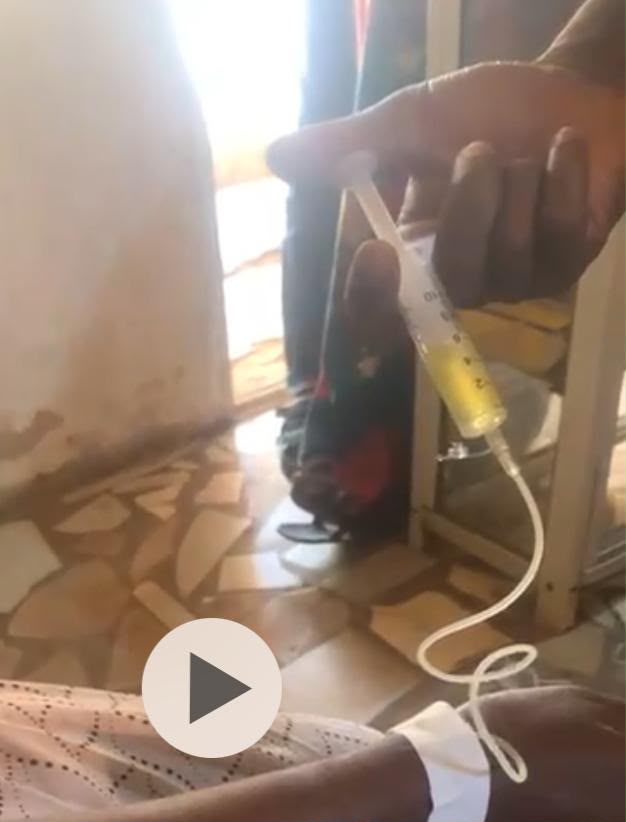
A still shot of the video clip provided by Maryam shows her receiving treatment at the store.
Despite Millions in Yearly Medical Fees, Suffering Still Persists
Investigations by Pen Press UDUS found that medical fees paid by students have amounted to a substantial sum over the past five academic sessions. Using the 23,491-student population cited in the 2025 Times Higher Education ranking and the medical fees identified by the investigation, Pen Press UDUS calculated that students have paid approximately ₦681,239,000 in medical fees between the 2021/2022 and 2025/2026 academic sessions.
The calculation puts the estimated medical-fee contribution at ₦117,455,000 for the 2021/2022 session, when the medical fee was ₦5,000 per student.
Following an increase to ₦6,000 in the 2022/2023 session, the same calculation produces ₦140,946,000 for each of the subsequent four sessions. This raises a question of whether the service being offered meets the standard of the revenue.
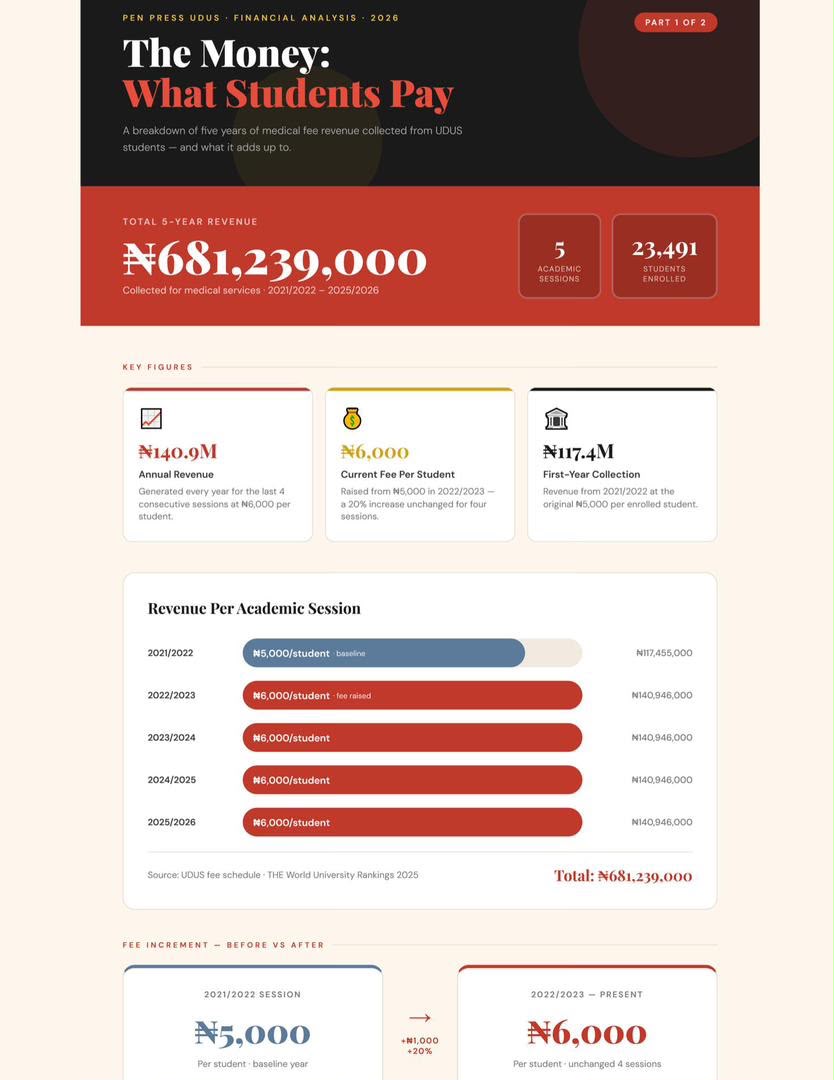
Infographics on the medical fees paid by students in five years
Health Risk Climbs Higher as Students Seek Alternatives
Oyewole Shareef, another 200-level Law student, said he had seen the pattern enough times to lose trust in the system.
He had accompanied friends to the school clinic when they needed urgent care and, according to him, repeatedly encountered situations where they waited for doctors.
On one occasion, he said he waited for two hours with a friend who was in serious discomfort before they eventually gave up and left. That was the last time he relied on the clinic as a first option. Now, whenever he falls ill, he said he goes straight to the same patent medicine store at the school mini mart, despite the financial difficulties he faces in paying for treatment.
Doctor Taofeeq Alao, a medical doctor practising in Osun State, said treatment by people without the appropriate clinical authority or training can expose patients to risks including misdiagnosis, inappropriate treatment, indiscriminate use of medicines, antimicrobial resistance and delayed presentation at formal health facilities.
“Many serious conditions are easily mistaken for mild conditions when doctors are not consulted appropriately, which contributes to risk of developing complications or even death at times,” he noted.
Cases like Amole’s, where students buy drugs they are already familiar with and take them without a prescription, reflect a pattern public health advocate Zakariya’u Dauda said extends well beyond UDUS. Dauda, who works on health-system issues linked to SDG 3, cited estimates that 38 to 56 percent of Nigerians self-medicate with antimicrobials, a figure that climbs to as high as 70 percent in Northern Nigeria. Many people, he said, mistakenly believe antibiotics can treat almost any illness, including colds and diarrhoea, and each unsupervised course makes resistant infections more common, leaving fewer options when antibiotics are genuinely needed.
Miss Olayiwola Hanat, a public health expert who specializes in Public Health Nutrition and Family and Reproductive Health also identified poor infection prevention and lack of continuity of care as possible consequences of unsafe healthcare practices.
“If needles, syringes, IV equipment or other materials are reused or improperly disposed of, both patients and healthcare workers can be exposed to infection,” she noted.
According to Hanat, a functional campus health service should have basic systems that allow patients to be properly assessed before treatment, access basic diagnostic investigations, receive clear referrals where necessary and have access to trained personnel, medicines and equipment capable of managing foreseeable emergencies and stabilising students before referral.
Her position is not simply that students should stop visiting patent medicine stores. Instead, she argues that the conditions pushing students away from formal healthcare need to be addressed. She also advocates for an environment where students can report poor experiences within university health facilities without fear of punishment or intimidation.
The Store at the Centre of the Dispute
The medicine store where Maryam said she received the injections is being regularly manned by a family connected to a registered community health practitioner who owns the store.
Rachael Al Hassan, who frequently attends to customers at the store, told Pen Press UDUS that students often come to the shop because they do not have clinic cards. She denied administering injections or drips at the store and said she only dispenses drugs and refers cases beyond her expertise to the clinic.
She further disclosed that her mother is the registered community health practitioner associated with the store. However, Maryam’s account and photographs provide evidence that she received injections while being treated at the premises.
The Pharmacy Council of Nigeria regulates Patent and Proprietary Medicine Vendors (PPMVs) and oversees their licensing and monitoring. Its current policy states that PPMVs are only licensed to sell over-the-counter medicines and health products, while the Council maintains inspection and monitoring functions for PPMV premises.
This is obviously in stark contradiction to the service the students interviewed for this story claim the patent store at the university provides.
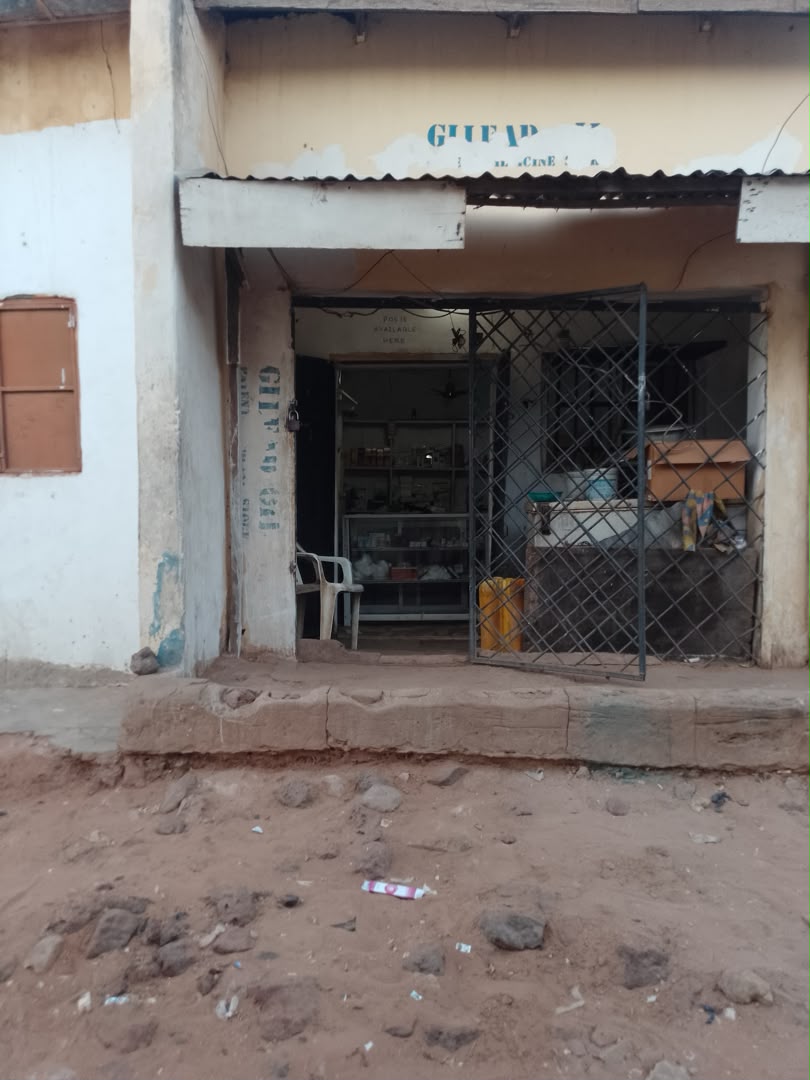
The patent store manned by Miss Rachel
Management Debunks Claims
Speaking with Pen Press UDUS, Professor Zayyanu Umar Usman, the Dean of Students’ Affairs, denied allegations that doctors are unavailable at the school clinic. He said the facility is well equipped and has sufficient doctors who work in shifts.
“While I don’t intend to defend the services being rendered in the school clinic, I am sure that we have enough doctors,” he affirmed.
He further stated that the management is committed to providing the best possible services to students and described the efforts involved in maintaining the system.
To corroborate his assertions, Professor Zayyanu placed a call to Dr Hameedah, one of the doctors working at the school clinic. Dr Hameedah said she had encountered situations where students spread what she described as false information about the services rendered at the clinic.
“We have even seen situations where more than one student shares a single card,” she noted.
While acknowledging that the clinic can sometimes be short of drugs, she said doctors have always been available and that, as of noon on April 23, 2026, three doctors were on duty.
She also described instances in which students who had gone to the mini mart for treatment later returned to the clinic for appropriate care after spending money at medicine stores.
The management’s position presents a different picture from the experiences described by the students interviewed for this story. The question, therefore, is not simply whether doctors are employed at the clinic, but whether students can reliably access them when they need care.
As complaints and denials continue to exist side by side, students like Abdulfatai, Amole, Maryam, and Oyewole are left to make difficult choices each time they fall ill. For them, the fear of waiting endlessly at the clinic now outweighs the fear of receiving treatment from unqualified hands, even when the consequences may be severe.